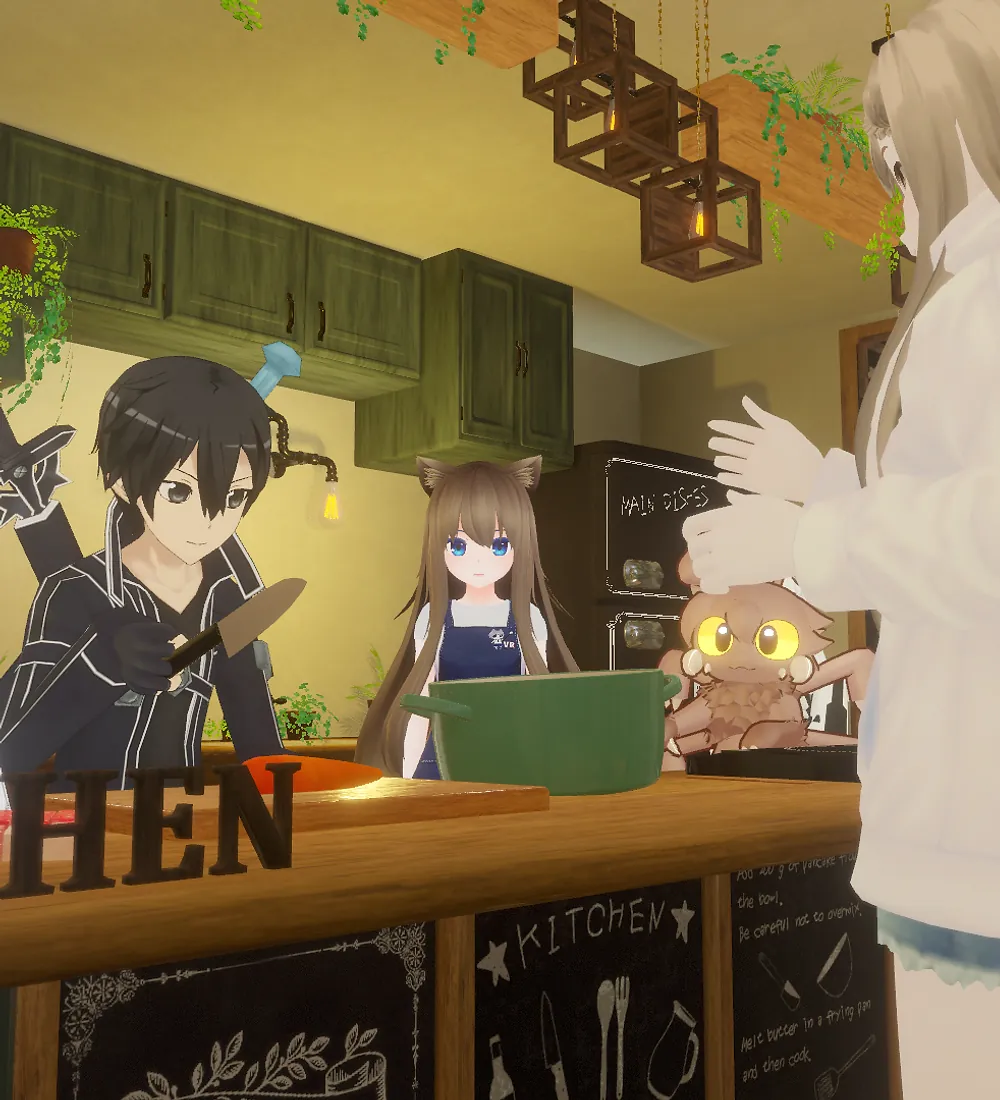
Moe’s VRChat teaching world · the practice below is written for this site.
The class before the class
First Class
Step into a scene from Moe’s VRChat teaching worlds. Start with a quiet self-introduction, then explore at your own pace. Read, listen, or speak if you want; this page never listens.
Each mission is one scene from the phrase decks on the home page, put back into the order it happens in, standing in a room from one of Moe’s own classes. Read it, hear it, say it — in any order you like.
から marks where you came from. 来ました means “came”; in a self-introduction, this polite sentence can tell someone your country of origin. You can use an imaginary country for practice.
3Say why you're here
This tells a new classmate that you are learning Japanese.
Here, 〜ています describes an ongoing activity: studying Japanese. It does not mean you must be studying at this exact moment. The particle を is pronounced o.
4Hand the turn back
You may hear this at the end of an introduction. Notice how it welcomes the relationship.
A polite way to close an introduction and begin a relationship. The meaning depends on the situation; “I look forward to learning with you” fits this classroom. よろしく alone is more casual.
1 / 4
VoiceKyoko · ElevenLabs v3
Difficulty
Two voices read the same words. Start with Kyoko; you can switch to Mayu to hear the same line in another voice.
If you freeze
Two lines that fit any of the scenes on this page. Neither one is an apology.
Kyoko uses ElevenLabs v3; Mayu uses Azure neural speech. Both are synthetic voices reading lines written for this site, not Moe, her students, or recordings from VRChat.
The four lines come from the Introduce yourself phrase deck on the home page.
Make one line your own
Imagine meeting a classmate from Canada. How could they say where they are from? Try recalling the sentence quietly, then open the example whenever you want. No answer to type or send.
Open a possible answer
カナダから来ました。 (Kanada kara kimashita.) — I’m from Canada. Replace アメリカ with カナダ; keep から来ました. A real or imagined place is fine.
You can leave it here, too. No need to finish every scene.
Next, you can watch Moe’s “Get to know each other” dice-talk class. It is a full group lesson with conversation beyond these greetings, not a recording of these site-written practice lines. The link opens YouTube, where playback data may be processed.
Kyoko uses ElevenLabs v3; Mayu uses Azure neural speech. Both are synthetic voices reading lines written for this site, not Moe, her students, or recordings from VRChat.
The four lines come from the Order at a café phrase deck on the home page.
03🛒Mission
At the convenience store
Two machines of cold drinks, one thing in your hand, and a queue that is not going to wait.
Kyoko uses ElevenLabs v3; Mayu uses Azure neural speech. Both are synthetic voices reading lines written for this site, not Moe, her students, or recordings from VRChat.
Kyoko uses ElevenLabs v3; Mayu uses Azure neural speech. Both are synthetic voices reading lines written for this site, not Moe, her students, or recordings from VRChat.
One participant names tsukemen as a favourite. The reply stacks short reactions, keeping the topic open for the next question.
Reveal the classroom move
The short backchannels do not carry new information. They give the learner room and momentum; the follow-up question proves the topic is worth extending.
The interview has reached preferences. どんな asks for a kind or quality rather than the name of one title.
Reveal the classroom move
どんな映画 asks for a category or character of film. A genre answer stays reusable; a single title is narrower than the slot the question opens.
Each Japanese excerpt comes from a published VR Nihongo class and may include Moe or a learner. Every explanation and choice was written for this site. The timestamp opens the original lesson.
What this page keeps in this browser
This browser keeps one small note for First Class, so the page can open where you left it: the room you were in and the line you had reached, whether the line was shown or hidden, which voice was reading, and which rooms you have walked to the end. It keeps no date, nothing you chose in a moment, and nothing about how you sounded, because this page never listens. There is no account behind it and Moe’s site makes no copy of it; your own browser decides its backups. It stays until you forget it here, or until your browser clears this site’s data.
Everything the public pages keep in this browser:
That was four lines.
Four lines is a reasonable amount to bring on a first night. The live classes do the same thing with other people in the room; in the VRChat class you are an avatar, not a face.
First Class is small on purpose.
These four rooms stay here whenever a familiar rehearsal would help. When you want a new place, the phrase practice page has more recorded lines from themes Moe has really taught — or come to the next live class.
The fifth room is the live class. That stamp is given in the room, not on this page.